

Loading blog post...
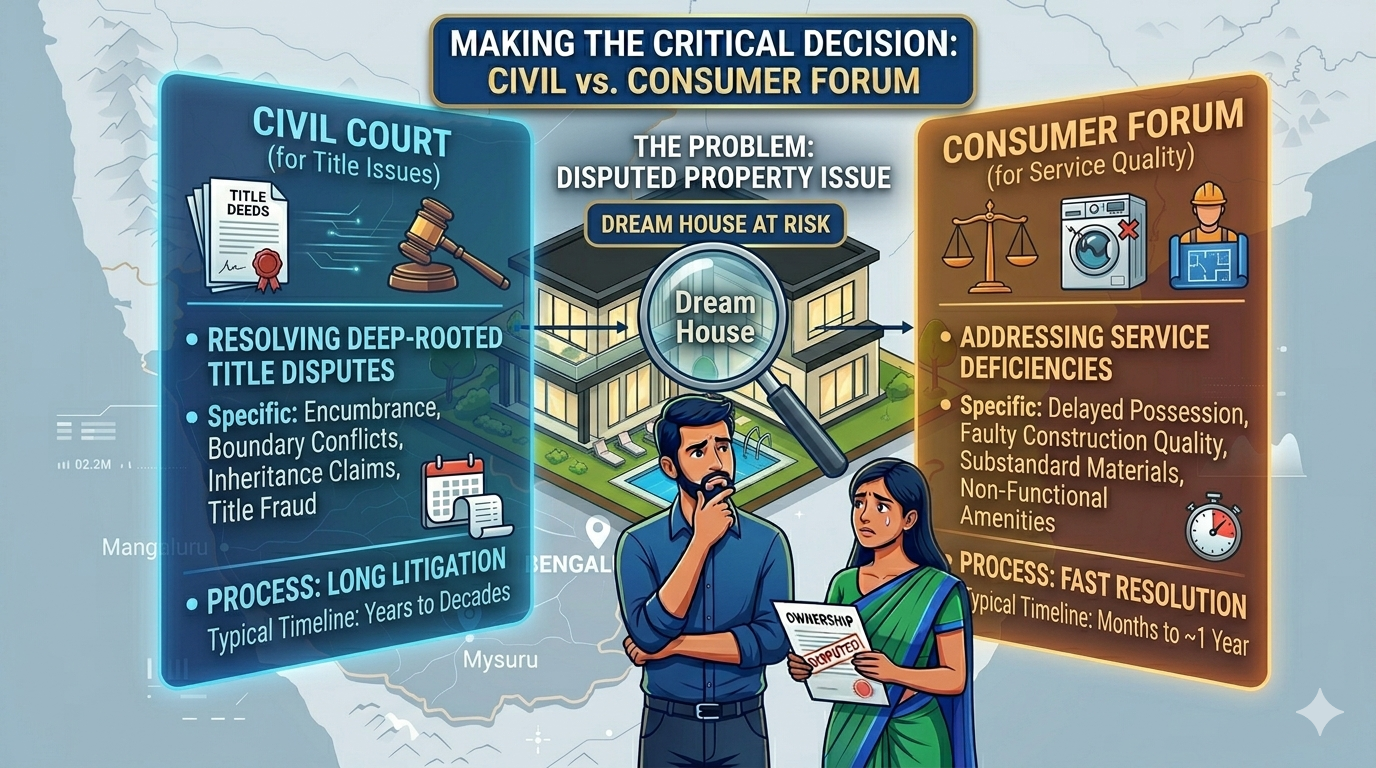
Imagine you have paid your hard-earned money for a flat in Bengaluru, only to discover that the builder has demolished a structure on the property, delayed possession by years, or handed over a unit riddled with defects. Your first instinct is to fight back legally — but where do you go? Do you file a complaint at the Consumer Forum, or do you approach the Civil Court? This is one of the most consequential decisions a property buyer in Karnataka can make, and getting it wrong can cost you years of litigation and lakhs in legal fees.
In May 2026, the Karnataka State Consumer Commission dismissed a compensation plea related to a demolished property, ruling that the matter was better suited for a Civil Court rather than a consumer forum. This landmark ruling has sent ripples through the Bengaluru property buyer community, raising urgent questions about the limits of consumer protection law in real estate disputes. At the same time, in December 2025, the same Commission held Ozone Urbana liable for delay in flat possession and ordered a refund along with loan-related relief — demonstrating that consumer forums can and do deliver justice in the right circumstances.
This guide is designed to help property buyers, NRIs, and legal professionals in Karnataka understand the critical differences between Consumer Forums and Civil Courts for property disputes in 2026, when each forum applies, what documents you need, and how to protect yourself before a dispute even arises.
A Consumer Forum, formally known as a Consumer Disputes Redressal Commission, is a quasi-judicial body established under the Consumer Protection Act, 2019. It is designed to provide speedy, affordable redressal to consumers who have suffered from deficient services or defective goods. In the context of real estate, it covers complaints against builders, developers, and housing societies for issues such as delayed possession, construction defects, false representations, and failure to provide promised amenities.
In Kannada, this is commonly referred to as ಗ್ರಾಹಕ ನ್ಯಾಯಾಲಯ (Grāhaka Nyāyālaya). The three tiers are:
A Civil Court is a court of general jurisdiction that adjudicates disputes involving property rights, title, ownership, possession, specific performance of contracts, injunctions, and damages. Civil Courts in Karnataka operate under the Code of Civil Procedure, 1908, and handle matters that require detailed examination of title documents, survey records, and complex questions of law. Civil suits are typically more time-consuming and expensive than consumer complaints but are essential for disputes involving property title or rights in rem.
The Karnataka Real Estate Regulatory Authority (K-RERA), established under the Real Estate (Regulation and Development) Act, 2016, is a specialised regulatory body for registered real estate projects. K-RERA handles complaints specifically against registered builders for issues like delayed possession, failure to hand over documents, and non-compliance with project specifications. It operates parallel to — and sometimes in conjunction with — consumer forums.
The May 2026 Karnataka State Consumer Commission ruling is a stark reminder that filing in the wrong forum can result in dismissal — not on merits, but on jurisdiction. When a dispute involves questions of title, ownership rights, or complex property law (such as whether a demolition was lawful), the Consumer Commission may decline jurisdiction and direct the complainant to a Civil Court. This wastes years and money.
Consumer forums are designed to resolve disputes within 90–150 days (though in practice timelines are longer). Civil suits in Karnataka can take 5–15 years. Filing fees at consumer forums are nominal compared to court fees in Civil Courts, which are calculated as a percentage of the claim value. For a ₹1 crore dispute, Civil Court fees alone can run into lakhs of rupees.
Consumer forums can award compensation, order refunds, and direct builders to complete construction or hand over possession. However, they cannot declare title, cancel sale deeds, or grant injunctions restraining third parties from dealing with property. Civil Courts can do all of this. If your dispute is fundamentally about who owns the property or whether a sale deed is valid, you must go to Civil Court.
For registered projects, K-RERA provides a faster and more targeted remedy. The Ozone Urbana case (December 2025) shows that the State Consumer Commission can still hold builders liable for possession delays even when K-RERA is available — but buyers must choose their forum strategically based on the specific relief they seek.
Non-Resident Indians purchasing property in Bengaluru often face challenges in personally attending hearings. Consumer forums now allow video conferencing in many cases, making them more accessible for NRIs. Civil Court proceedings, however, typically require physical presence or a duly authorised Power of Attorney holder in Karnataka.
Under the Consumer Protection Act, 2019, complaints must be filed within two years of the cause of action arising. Civil suits for specific performance must be filed within three years. Missing these deadlines can permanently bar your claim, regardless of its merits.
| Factor | Consumer Forum | Civil Court | K-RERA |
|---|---|---|---|
| Governing Law | Consumer Protection Act, 2019 | Code of Civil Procedure, 1908 | RERA Act, 2016 |
| Typical Timeline | 1–3 years (in practice) | 5–15 years | 60–90 days (adjudication) |
| Filing Fees | Nominal (₹200–₹5,000) | High (% of claim value) | Nominal |
| Can Declare Title? | No | Yes | No |
| Can Order Refund? | Yes | Yes (as damages) | Yes |
| Can Grant Injunction? | Limited | Yes | No |
| Covers Unregistered Projects? | Yes | Yes | No |
| NRI-Friendly? | Moderately (VC allowed) | Less so | Moderately |
| Limitation Period | 2 years | 3 years (specific performance) | 5 years (from possession) |
Before filing anywhere, clearly define what you are seeking. Is it a refund for delayed possession? Compensation for construction defects? Declaration of title? Cancellation of a fraudulent sale deed? The nature of your relief determines your forum. Use this as your primary filter:
Regardless of the forum, you will need a comprehensive set of documents. Missing documents are one of the most common reasons complaints are delayed or dismissed. Use Legal Byte's DocGet service to retrieve missing records from Kaveri Online (sale deeds, encumbrance certificates), Bhoomi (RTC/pahani records), BBMP e-AASTHI (property tax records), and K-RERA (project registration details).
Visit the K-RERA portal and verify whether your project is registered. Note the RERA registration number, project completion date, and any complaints already filed against the builder. This information is critical for both K-RERA complaints and consumer forum filings.
Before filing in any forum, send a formal legal notice to the builder or opposite party through a registered advocate. This is a prerequisite in many cases and demonstrates good faith. Retain proof of delivery.
For Consumer Forum: File a written complaint with supporting documents at the appropriate District or State Commission in Karnataka. For Civil Court: File a plaint through an advocate at the appropriate Civil Court (City Civil Court in Bengaluru for most urban property disputes). For K-RERA: File online through the K-RERA portal with project details and supporting documents.
Ensure timely attendance or representation at all hearings. In consumer forums, non-appearance can result in ex-parte orders. In Civil Courts, delays in filing written statements or attending hearings can result in adverse orders.
| Document | Purpose | Source |
|---|---|---|
| Sale Deed / Agreement for Sale | Proves purchase and terms agreed | Kaveri Online / Personal Records |
| Encumbrance Certificate (EC) | Shows transaction history and encumbrances | Kaveri Online |
| Khata Certificate and Extract | Confirms property tax assessment and ownership | BBMP e-AASTHI / CMC |
| RTC / Pahani (for land) | Shows land ownership and cultivation details | Bhoomi Portal |
| K-RERA Registration Certificate | Confirms project is registered under RERA | K-RERA Portal |
| Builder-Buyer Agreement | Details of payment schedule and possession date | Personal Records |
| Payment Receipts / Bank Statements | Proof of amounts paid to builder | Personal Records / Bank |
| Allotment Letter | Confirms unit allotted by builder | Personal Records |
| Possession Letter (if any) | Confirms date of possession offered | Personal Records |
| Approved Building Plan | Verifies construction is as per sanctioned plan | BBMP / BDA / Local Authority |
| Occupancy Certificate (OC) | Confirms building is fit for occupation | BBMP / BDA |
| Legal Notice Copy with Proof of Delivery | Demonstrates pre-litigation notice to builder | Personal Records |
The Karnataka State Consumer Commission's May 2026 ruling dismissing a compensation plea over a demolished property is a cautionary tale. When disputes involve questions of whether a demolition was lawful, who had the right to demolish, or what the property's legal status was at the time, these are fundamentally civil law questions. Filing such matters in a consumer forum risks dismissal on jurisdictional grounds, wasting years of effort. Always consult a property lawyer to identify the correct forum before filing.
A significant number of consumer complaints and civil suits in Karnataka are delayed because buyers cannot produce key documents — particularly older sale deeds, mutation records, or encumbrance certificates. Many buyers do not realise that these can be retrieved digitally from Kaveri Online, Bhoomi, and BBMP e-AASTHI.
K-RERA only covers registered projects. Many smaller developments in Bengaluru's peripheral areas — particularly in areas like Devanahalli, Anekal, and Sarjapur — may not be K-RERA registered. Buyers of such properties must rely on consumer forums or civil courts, making pre-purchase due diligence even more critical.
Buyers who wait too long to file complaints — often hoping the builder will resolve issues amicably — find themselves time-barred. The two-year limitation for consumer complaints runs from the date the cause of action arises (e.g., the promised possession date), not from when you finally give up on the builder.
If a builder has been admitted to insolvency proceedings before the National Company Law Tribunal (NCLT), consumer forum proceedings may be stayed. Homebuyers in such cases must file claims before the Resolution Professional under the Insolvency and Bankruptcy Code, 2016 — a completely different process.
Consumer forums and civil courts have concurrent jurisdiction in some matters. Filing in both simultaneously can lead to complications. Courts may stay one proceeding pending the outcome of the other. Always take legal advice before filing in multiple forums.
Most property disputes in Karnataka could be prevented entirely with thorough pre-purchase due diligence. Buyers who skip title verification, encumbrance checks, and BBMP e-AASTHI khata verification often discover problems only after paying in full — by which time their options are limited to expensive litigation.
Legal Byte's flagship service, Scrutin 360, conducts comprehensive AI-powered property due diligence that examines title history, encumbrances, litigation status, K-RERA compliance, BBMP e-AASTHI khata records, and Bhoomi land records — all in one integrated report. By identifying red flags before you sign any agreement, Scrutin 360 helps you avoid the situations that lead to consumer forum and civil court battles in the first place. For NRI buyers who cannot physically visit Bengaluru to verify documents, Scrutin 360 provides a reliable remote due diligence solution.
If you are already in a dispute and struggling to gather documents for your complaint or suit, Legal Byte's DocGet service retrieves missing property documents from Kaveri Online (sale deeds, encumbrance certificates), Bhoomi (RTC/pahani records for agricultural and converted land), BBMP e-AASTHI (khata certificates and extracts), and K-RERA (project registration and complaint records). Having a complete document set dramatically improves your chances of success in any forum.
Legal Byte's platform provides Karnataka-specific guidance on whether your dispute is best suited for the Consumer Commission, K-RERA, or Civil Court — helping you avoid the costly mistake of filing in the wrong forum, as illustrated by the May 2026 Karnataka State Consumer Commission ruling.
The Karnataka State Consumer Commission's May 2026 ruling dismissing a compensation plea over a demolished property is a watershed moment for property buyers in Bengaluru and across Karnataka. It underscores a fundamental truth: consumer forums are powerful tools for addressing builder deficiencies, delays, and service failures — but they are not a universal remedy for all property disputes. When matters involve questions of title, demolition rights, or complex property law, the Civil Court remains the appropriate forum. Conversely, the December 2025 Ozone Urbana ruling shows that consumer forums can deliver swift and meaningful relief when the dispute genuinely involves deficiency in service by a builder.
The key to protecting yourself is two-fold: conduct thorough due diligence before purchasing any property in Karnataka, and take expert legal advice before choosing your dispute resolution forum. Missing documents, wrong forum selection, and lapsed limitation periods are the three most common reasons property buyers in Karnataka lose cases they should have won. With the right preparation — including verified title records from Kaveri Online, Bhoomi, and BBMP e-AASTHI, and K-RERA compliance checks — most disputes can be either prevented entirely or resolved efficiently.
Legal Byte's Scrutin 360 and DocGet services are specifically designed to give Karnataka property buyers, NRIs, and legal professionals the document intelligence and due diligence support they need to make informed decisions — before purchase and during disputes. Do not wait until you are in a courtroom to discover what your property documents say. Visit legalbyte.ai today to run a Scrutin 360 due diligence report or use DocGet to retrieve your missing property documents from Kaveri Online, Bhoomi, BBMP e-AASTHI, or K-RERA.

LegalByte (Lexipro Solutions Pvt. Ltd.) is not a law firm and does not provide legal advice. Reports are for informational purposes only and do not constitute legal opinion. Engage a qualified advocate for registration, disputes, or complex transactions.
© 2025 NVIDIA, the NVIDIA logo, are trademarks and/or registered trademarks of NVIDIA Corporation in the U.S. and other countries.
