
Loading blog post...
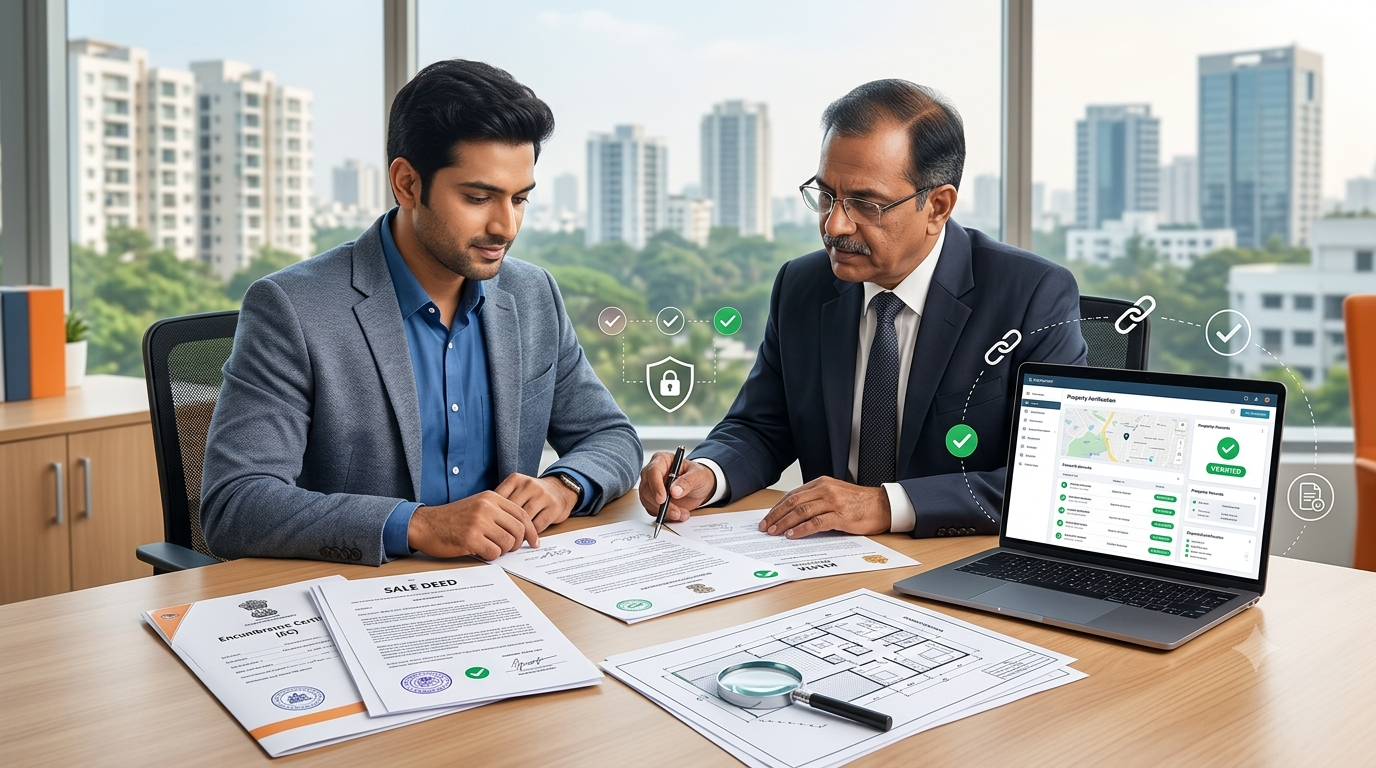
Every year, thousands of property buyers in Bangalore skip a proper verification and rely on a "quick lawyer opinion" — a 30-minute document glance that misses exactly the kind of problems that surface years later, when a bank refuses a loan against the property or a buyer discovers the seller never had a clear title in the first place.
This guide walks through what property verification in Bangalore actually involves, step by step, so you know what to check yourself and what to hand to a professional.
Property verification means confirming three things before you pay a single rupee: that the seller legally owns the property, that the property is free of hidden loans or disputes, and that the building or plot has the approvals it needs to be legally habitable or developable.
It is different from a full due diligence report — verification is the confirmation step; due diligence is the complete investigation that produces it.
The khata certificate is BBMP's record of who owns a property for tax purposes. In Bangalore, this comes in two forms: A-Khata, granted to properties within full BBMP jurisdiction with legal standing, and B-Khata, issued for properties with some regulatory gap — often unapproved layouts.
Check the khata online via BBMP's e-Aasthi portal, and confirm the name, survey number, and property tax payment history match what the seller has told you. A B-Khata property isn't automatically a dealbreaker, but it changes what you can and can't do with the property — including getting a home loan.
The EC, available via the Kaveri Online Services portal, lists every registered transaction on a property for a given period — sales, mortgages, leases, and liens. Always request Form 15, which gives the full transaction history, rather than Form 16, which only confirms encumbered or not.
A clean EC for the requested period is a good sign, but it only covers what's registered — it won't show an unregistered dispute or an informal family claim. That's why the EC is one input into verification, not the whole picture.
This is the step most self-checks and quick lawyer reviews skip. A proper title trace follows ownership back at least 30 years — through every sale, gift, partition, or inheritance — checking that each link in the chain is a valid, registered transaction with no gaps.
A gap in the chain — a missing registration, an unclear inheritance, an unresolved family partition — is exactly the kind of defect that can surface years later as a legal dispute over your property.
For apartments and constructed properties, verify the BBMP or BDA-sanctioned building plan, and confirm the Occupancy Certificate (OC) and Completion Certificate (CC) were issued. Many properties in Bangalore are occupied without a proper OC — which can create problems at resale or when applying for a loan.
For under-construction projects, check the K-RERA registration on the Karnataka RERA portal. This confirms the project is registered with the regulator, though it doesn't independently verify the specific unit's title.
The final step is cross-referencing survey numbers, owner names, and registration dates across the khata, EC, sale deed, and — where applicable — Bhoomi/RTC land records. Inconsistencies between these sources are often the first sign of a forged document or a benami (proxy) ownership arrangement.
Done manually by an independent lawyer, a thorough verification takes 5–14 days and typically costs ₹12,000–₹20,000 in Bangalore. LegalByte runs the same checks with AI-assisted document analysis, delivering a lawyer-signed Risk Check in 48 hours for ₹8,500 + taxes, or a full Due Diligence Report in 72 hours for ₹14,000 + taxes.
If the property has changed hands multiple times, has any B-Khata history, is older construction without a clear OC, or you simply want a title trace done properly rather than skimmed, it's worth getting a lawyer-reviewed verification rather than relying on self-checks alone.
Property verification in Bangalore isn't complicated, but it is easy to do partially and think you're covered. Khata, EC, title chain, and building approvals — all four, cross-checked against government records — is what actually protects you. If you want this done thoroughly and quickly, LegalByte's property verification service delivers a lawyer-signed report in 48–72 hours.

LegalByte (Lexipro Solutions Pvt. Ltd.) is a technology-enabled due diligence platform, not a law firm. Reports reviewed and signed off by an advocate constitute that advocate’s legal opinion, subject to the scope and qualifications stated in the report. Reports and analyses without that sign-off are informational only and do not constitute a legal opinion.
© 2025 NVIDIA, the NVIDIA logo, are trademarks and/or registered trademarks of NVIDIA Corporation in the U.S. and other countries.
