

Loading blog post...
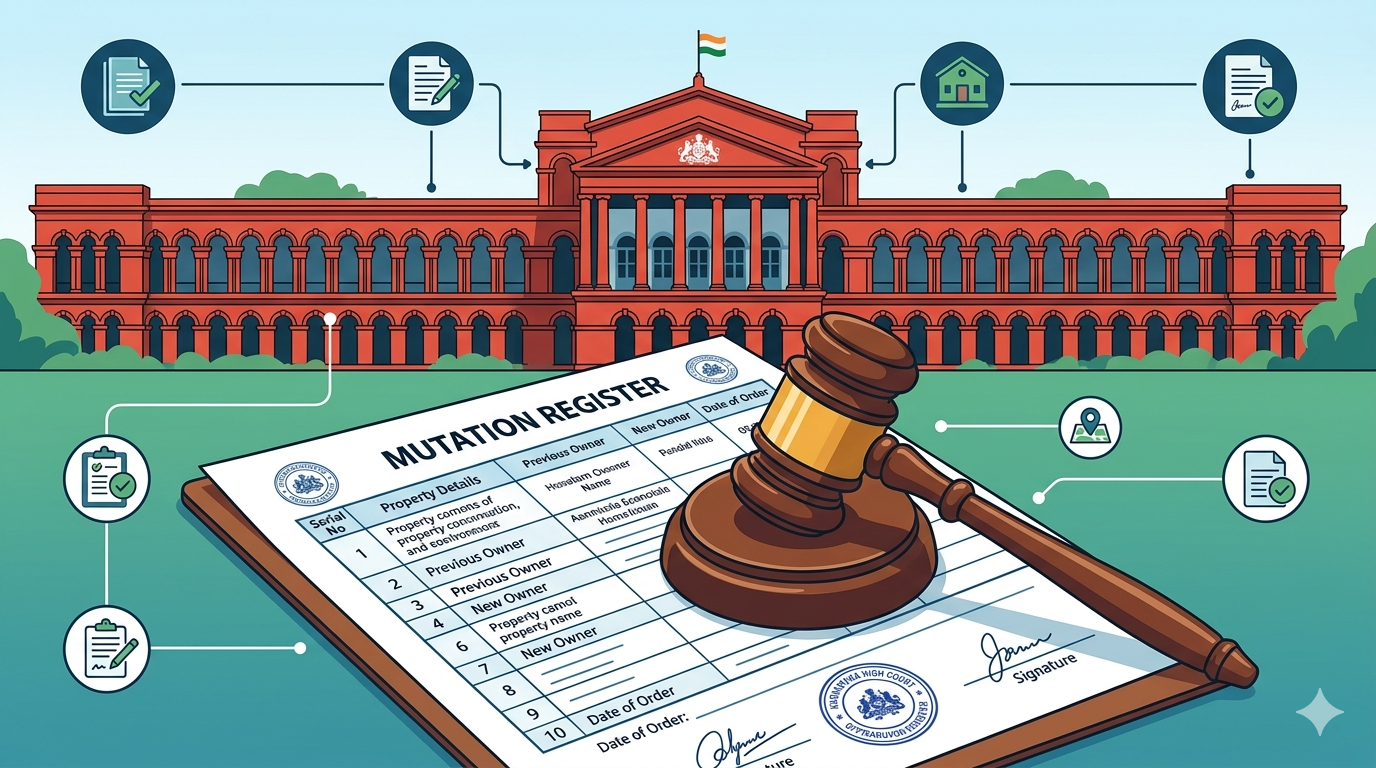
In April 2026, the Karnataka High Court delivered a landmark judgment that sent ripples through the state's property and revenue administration landscape. The court partially invalidated an amended law governing appeals in land mutation disputes — a ruling that directly affects thousands of property owners, farmers, NRIs, and real estate buyers across Karnataka who rely on mutation records to establish lawful ownership.
If you own land in Karnataka, or in the process of buying property in Bangalore, or have ever dealt with a khata or RTC (Record of Rights, Tenancy and Crops) update, this ruling has implications you cannot afford to ignore. Mutation — the process of updating land ownership records in government registers — is the bedrock of property title security in Karnataka. When disputes arise over mutation, the appeals process determines who ultimately gets recognised as the lawful owner. The High Court's intervention signals that the legislative framework governing those appeals had serious legal infirmities.
This guide breaks down what land mutation is, why the appeals process matters, what the High Court ruling changes, and — critically — how you can protect yourself when buying or holding property in Karnataka today.
Land mutation (also called ಭೂ ಮ್ಯುಟೇಶನ್ in Kannada, or Hakkina Badlavaṇe) is the process of updating the government's land revenue records to reflect a change in ownership. When a property is sold, inherited, gifted, or transferred in any way, the new owner must apply for mutation so that the revenue records — primarily the Record of Rights, Tenancy and Crops (RTC/Pahani) maintained on the Bhoomi portal — reflect the correct owner's name.
Mutation is distinct from registration of a sale deed (done through Kaveri Online) but equally important. A registered sale deed proves the transaction happened; mutation proves the government recognises you as the current owner for revenue and tax purposes. Without mutation, you may face difficulties in obtaining loans, paying property tax, or selling the property in the future.
| Term | Meaning | Relevant Portal |
|---|---|---|
| Mutation / Hakkina Badlavaṇe | Update of ownership in revenue records | Bhoomi |
| RTC / Pahani | Record of Rights, Tenancy and Crops — the primary land record | Bhoomi |
| Khata | Municipal ownership record for urban properties | BBMP e-AASTHI |
| Encumbrance Certificate (EC) | Document showing all registered transactions on a property | Kaveri Online |
| Mutation Appeal | Legal challenge to a mutation order by an aggrieved party | Revenue courts / High Court |
Mutation disputes are among the most common — and most contentious — property conflicts in Karnataka. They arise when:
The appeals process is the safety valve that allows aggrieved parties to challenge a mutation order before a higher revenue authority or court. When the law governing that appeals process is flawed — as the Karnataka High Court has now found — it creates a vacuum of legal uncertainty that can freeze property transactions, delay loan disbursements, and leave genuine owners without a remedy.
In April 2026, the Karnataka High Court partially invalidated the amended law on appeals in land mutation disputes, as reported by The Hindu. While the full text of the judgment is subject to legal analysis, the ruling indicates that certain provisions introduced by the amendment — likely relating to the forum, timeline, or procedure for filing mutation appeals — were found to be unconstitutional or ultra vires the parent statute.
This is not an isolated development. It follows a period of heightened scrutiny of Karnataka's revenue administration. In November 2025, Lokayukta raids on revenue offices in a khata bribery case exposed systemic corruption in the mutation and khata issuance process. In December 2025, the Greater Bengaluru Authority (GBA) was forced to audit rejected e-khata applications after employees protested irregularities. Together, these events paint a picture of a revenue system under stress — and a judiciary stepping in to restore legal order.
If you have an ongoing mutation appeal that was filed under the now-invalidated provisions, you may need to re-file under the restored or surviving legal framework. Consult a property lawyer immediately to assess whether your appeal is affected.
With the appeals framework in flux, a property that appears to have a clean mutation record today could be subject to a challenge tomorrow — especially if the previous mutation was contested and the appeal was dismissed under the invalidated provisions. This makes thorough title verification more critical than ever.
NRIs and those who inherited Karnataka land but live elsewhere are particularly vulnerable to fraudulent mutations. If the appeals mechanism was weakened by the amended law, fraudulent mutations may have gone unchallenged. The High Court ruling may reopen the window for such challenges.
Banks and housing finance companies in Karnataka already scrutinise mutation records before disbursing home loans. In the wake of this ruling, expect lenders to demand more comprehensive title reports and mutation history before approving loans on disputed or recently mutated properties.
Understanding how mutation works helps you identify where disputes can arise and what documents you need to protect your rights.
| Document | Purpose |
|---|---|
| Registered Sale Deed / Gift Deed / Will | Proof of transfer of ownership |
| Encumbrance Certificate (EC) from Kaveri Online | Confirms no prior encumbrances on the property |
| Previous RTC / Pahani from Bhoomi | Shows current ownership before mutation |
| Identity Proof of Applicant | Aadhaar, PAN, or passport |
| Death Certificate + Legal Heir Certificate (for inheritance) | Establishes right to inherit |
| Court Order (if applicable) | For mutation based on a decree |
| Property Tax Receipts | Proof of possession and payment history |
Legal Byte's Scrutin 360 service uses AI to analyse all property documents — including sale deeds, RTCs, ECs, and khata certificates — and flags inconsistencies, gaps in the ownership chain, and mutation discrepancies before you commit to a purchase. In the current environment, where the mutation appeals framework itself has been legally challenged, having an AI-powered review of your property's mutation history is not a luxury — it is a necessity.
One of the most common obstacles in mutation due diligence is missing or inaccessible documents. Legal Byte's DocGet service retrieves critical records directly from government portals — including RTCs and mutation entries from Bhoomi, encumbrance certificates from Kaveri Online, khata details from BBMP e-AASTHI, and project registration details from K-RERA — so you have a complete picture of the property's legal status without the hassle of navigating multiple portals yourself.
If you are already involved in a mutation dispute or appeal, Legal Byte can connect you with experienced property lawyers in Karnataka who understand the implications of the April 2026 High Court ruling and can advise you on the correct forum and procedure for your appeal in light of the partially invalidated law.
For a deeper understanding of related topics, see our guides on RTC and Pahani records on Bhoomi, Khata certificates in Bangalore, Encumbrance Certificates in Karnataka, and Mother Deeds and title chain verification.
The Karnataka High Court's April 2026 ruling partially invalidating the amended mutation appeals law is a stark reminder that property ownership in Karnataka is only as secure as the legal framework protecting it — and that framework can change. For property buyers, landowners, and NRIs, the message is clear: mutation records must be verified with greater rigour than ever before, and any property with a history of mutation disputes deserves careful legal scrutiny before you invest your money.
The broader context — Lokayukta raids on revenue offices, audits of rejected e-khata applications, and now a High Court intervention in the appeals process — underscores that Karnataka's land records system, while improving through digital portals like Bhoomi, BBMP e-AASTHI, and Kaveri Online, remains vulnerable to fraud, administrative error, and legal uncertainty. Protecting yourself requires proactive due diligence, not reactive damage control.
Legal Byte's Scrutin 360 gives you an AI-powered analysis of every document in your property's chain of title, flagging mutation gaps, encumbrance issues, and legal risks before you sign. And if you need to retrieve RTCs, ECs, khata records, or K-RERA documents from government portals, DocGet does it for you — fast, accurately, and without the bureaucratic runaround. Don't let a mutation dispute become your problem. Start your due diligence with Legal Byte today.

LegalByte (Lexipro Solutions Pvt. Ltd.) is a technology-enabled due diligence platform, not a law firm. Reports reviewed and signed off by an advocate constitute that advocate’s legal opinion, subject to the scope and qualifications stated in the report. Reports and analyses without that sign-off are informational only and do not constitute a legal opinion.
© 2025 NVIDIA, the NVIDIA logo, are trademarks and/or registered trademarks of NVIDIA Corporation in the U.S. and other countries.
