

Loading blog post...
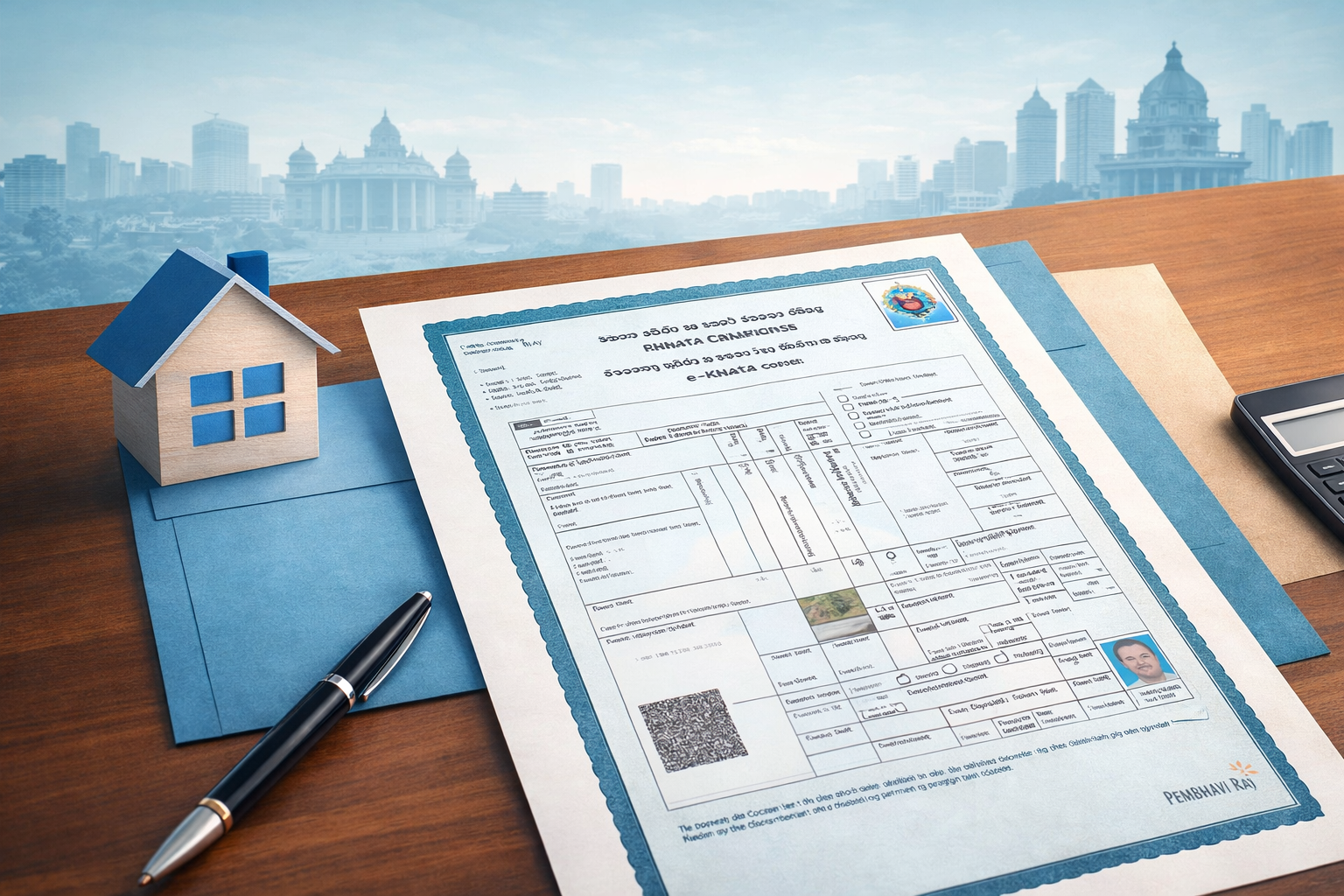
Imagine finalising your dream apartment in Bengaluru, only to discover months later that the property lacks a valid Khata — making it impossible to secure a home loan, obtain a building plan sanction, or even pay property tax in your name. This scenario plays out far too often for unsuspecting buyers in Bengaluru's fast-moving real estate market. The Khata Certificate is not merely a bureaucratic formality; it is the foundational document that connects your property to the municipal system of the Bruhat Bengaluru Mahanagara Palike (BBMP), now operating alongside the Greater Bengaluru Authority (GBA) framework introduced in 2024.
In 2025–2026, Bengaluru's property registration ecosystem has undergone significant digital transformation. As of May 2026, over 25 lakh properties across Bengaluru have been brought under the unified e-Khata system, according to Karnataka's Deputy Chief Minister. Simultaneously, the "My e-Khata, My Hakku" campaign — which received nearly 3,000 applications within weeks of its launch — has made it easier than ever for property owners to regularise their records. Yet a June 2026 report in The Hindu noted that apartment dwellers are still finding limited relief from the one-time Occupancy Certificate waiver and the A Khata drive, underscoring that the process remains far from seamless for many buyers. Confusion around A Khata versus B Khata, the e-Khata migration, and Occupancy Certificate linkage continues to trip up buyers and sellers alike.
This comprehensive guide covers everything you need to know about the Khata Certificate in Bengaluru in 2026 — what it is, why it matters, how to apply online and offline, what documents you need, and the critical red flags to watch for before you sign on the dotted line.
The word Khata (ಖಾತೆ) is a Kannada term meaning "account." A Khata Certificate is a revenue document issued by BBMP (or the relevant urban local body) that records a property in the municipal assessment register and identifies the person liable to pay property tax on it. Think of it as the municipal identity card for your property.
Critically, a Khata Certificate does not establish ownership of the property — that function belongs to the Sale Deed and Encumbrance Certificate. What the Khata does is confirm that BBMP has assessed the property for tax purposes and that a specific person is recorded as the responsible taxpayer. It is issued alongside a Khata Extract, which contains detailed property data including area, location, and tax assessment number.
Under Bengaluru's e-Khata system — accessible through the BBMP e-AASTHI portal — Khata records are now digitised and linked to property identification numbers, making it possible to retrieve and verify Khata details online. NRIs and outstation buyers in particular benefit from this digital shift, as they can check a property's Khata status without visiting Bengaluru.
One of the most consequential and frequently misunderstood aspects of Bengaluru property law is the difference between A Khata and B Khata. The distinction affects your ability to obtain loans, get building plan sanctions, and sell the property freely.
| Feature | A Khata | B Khata |
|---|---|---|
| BBMP Assessment Register | Main Register (Form A) | B Register (informal list) |
| Property Status | Shows property conforms to approved plan / regularisation completed | Shows property may have deviations or be in a revenue layout without full BBMP approval |
| Home Loan Eligibility | Generally accepted by banks | Most banks decline or apply stricter conditions |
| Building Plan Sanction | Eligible to apply | Not eligible |
| Trade Licence / BBMP Permissions | Eligible | Not eligible |
| Resale | Broader buyer pool | Limited; buyers face the same restrictions |
A B Khata property is not necessarily illegal, but it shows that the property has not completed the full regularisation process or does not yet meet BBMP's approval requirements. Buyers should understand exactly what the Khata status shows about the property before proceeding.
Virtually every scheduled bank and housing finance company operating in Karnataka requires a valid A Khata as part of the property document checklist for home loans. Without it, loan disbursement is typically refused or significantly delayed. For NRIs relying on overseas income, this is especially critical — a property without an A Khata can freeze your entire acquisition plan.
Any structural addition, floor extension, or new construction requires BBMP's building plan sanction. BBMP processes these applications only for properties that hold an A Khata. If you plan to customise or develop a plot or independent house in Bengaluru, the Khata status is non-negotiable.
Property tax in Bengaluru is assessed and collected under the Khata. A Khata transfer after a sale ensures that tax dues are correctly attributed to the new owner. Failure to transfer the Khata can result in outstanding dues appearing against the seller's name — or worse, against the property itself — which complicates future transactions.
When you eventually sell the property, buyers and their banks will request the Khata Certificate and Extract. A property that shows a clean, current A Khata in the seller's name commands greater confidence and a broader buyer pool.
A Khata's status often reflects whether a property has gone through required regularisations — such as the Akrama Sakrama scheme for revenue layouts, or the Occupancy Certificate process for apartments. A property stuck on B Khata after multiple years may indicate unresolved compliance issues that a buyer inherits.
For NRIs managing Bengaluru properties remotely, the digital e-Khata on BBMP e-AASTHI makes it possible to check tax dues, download the Khata Extract, and verify the current registered owner — all without a physical visit to BBMP ward offices.
The e-Khata system — hosted on the BBMP e-AASTHI portal — is the most significant shift in Bengaluru's property tax administration in recent years. As of May 2026, over 25 lakh properties have been migrated to the system, according to Karnataka's Deputy Chief Minister. Each property is assigned a unique Property Identification Number (PID), linking physical property data with digital tax records.
Key features of the e-Khata system include:
The "My e-Khata, My Hakku" campaign, launched in May 2026, received 2,939 applications within weeks, reflecting strong demand from property owners seeking to regularise their digital records. However, as The Hindu reported in June 2026, apartment owners — particularly in layouts that still lack Occupancy Certificates — continue to face hurdles even under the one-time waiver scheme, and the conversion from B Khata to A Khata is not yet automatic for all such properties.
A Khata transfer is required every time a property changes hands. It must be applied for within a reasonable period after the Sale Deed is registered on Kaveri Online. The registered Sale Deed number and Encumbrance Certificate from Kaveri Online are mandatory for the transfer application. Failure to initiate Khata transfer promptly can result in property tax notices continuing to be issued in the previous owner's name.
| Document | Purpose |
|---|---|
| Registered Sale Deed (certified copy) | Establishes ownership and transaction details; obtainable from Kaveri Online |
| Encumbrance Certificate (Form 15 or Form 16) | Shows the property's transaction history and absence of mortgages; obtainable from Kaveri Online |
| Previous Khata Certificate and Extract | Shows the prior Khata record for transfer purposes |
| Latest Property Tax Payment Receipt | Confirms no outstanding dues as of the date of application |
| Occupancy Certificate (for apartments) | Required for A Khata issuance; shows the building was constructed as per approved plan |
| Approved Building Plan (for independent houses/plots) | Shows BBMP-sanctioned construction plan |
| Betterment Charges Receipt (if applicable) | Proof of payment of charges levied for civic amenity improvements in layouts |
| Conversion Order from Bhoomi (if applicable) | Required for properties converted from agricultural land; obtainable from Bhoomi portal |
| Identity Proof of Applicant (Aadhaar / Passport for NRIs) | KYC requirement |
| Power of Attorney (for NRIs applying through a representative) | Authorises a local representative to act on the NRI's behalf |
Some properties have been on B Khata for years with no Occupancy Certificate and no regularisation scheme covering them. Before purchase, verify through BBMP e-AASTHI whether the current Khata is A or B, and ask the seller for documentary evidence of the regularisation pathway — not just verbal assurances.
A mismatch between the name on the Khata and the name on the most recent registered Sale Deed is a significant red flag. It may indicate an unregistered transfer in the chain, a disputed ownership claim, or a clerical error that can take months to resolve. Cross-check the Kaveri Online records against the Khata carefully.
Tax dues attach to the property, not just the owner. If the seller has unpaid arrears, BBMP can demand payment from the new owner or deny Khata transfer until dues are cleared. Always obtain a tax dues clearance from BBMP e-AASTHI before completing the purchase.
Buyers often neglect Khata transfer after taking possession. Without it, tax notices continue going to the seller, tax dues may be missed, and any future BBMP permissions will be unprocessable. Khata transfer must be initiated promptly after sale deed registration.
Many Bengaluru apartment projects — especially those completed before stricter enforcement — were issued B Khatas because the builder never obtained the Occupancy Certificate (OC). Even under the 2026 one-time OC waiver drive, not all such apartments qualify automatically, as The Hindu's June 2026 report noted. Buyers should verify the building's OC status through K-RERA or BBMP records before purchase.
Plots in revenue layouts that were never converted and approved by BDA or BBMP may show a Khata on the B Register but cannot obtain A Khata until the layout is regularised. Such properties carry significant compliance risk for buyers.
In a few documented cases, fraudulent Khata Certificates have been used to facilitate property fraud. The QR code on e-Khata Certificates can be scanned to verify their authenticity against the BBMP e-AASTHI database. Always insist on downloading the Khata directly from BBMP e-AASTHI rather than relying on a printout provided by the seller.
Legal Byte's Scrutin 360 due diligence service cross-checks a property's Khata status — including whether it is A Khata or B Khata, whether it matches the registered owner on Kaveri Online, and whether any outstanding tax dues are reflected — as part of a comprehensive pre-purchase property risk assessment. Our lawyer-reviewed reports flag Khata mismatches, B Khata status, missing OC, and revenue layout issues so you understand exactly what the documents show before you commit.
If key documents like the Khata Certificate, Encumbrance Certificate, or Occupancy Certificate are missing or unavailable from the seller, Legal Byte's DocGet service retrieves them directly from BBMP e-AASTHI, Kaveri Online, Bhoomi, and K-RERA — the four portals that hold Bengaluru's authoritative property records. This is especially useful for NRI buyers who cannot physically visit government offices.
| Service | What It Covers | Price (incl. GST) |
|---|---|---|
| Risk Check | AI-powered flags on Khata status, title chain, encumbrances, RERA compliance | ₹8,500 |
| Due Diligence Report | Full lawyer-reviewed report including Khata analysis, OC status, encumbrance history, tax dues | ₹14,000 |
Both reports are delivered within 48–72 hours. DocGet document retrieval is available as a standalone add-on or as part of either report when source documents are unavailable.
The Khata Certificate occupies a central position in Bengaluru's property ecosystem. It is the document that connects your property to BBMP's municipal records, determines your eligibility for home loans and building permissions, and reflects the property's compliance history in a single, retrievable record. In 2026, with over 25 lakh properties now under the e-Khata system and the BBMP e-AASTHI portal making Khata records digitally accessible, buyers have more tools than ever to check a property's status — but the process still requires careful, document-by-document verification. As recent experience shows, even ongoing government drives to regularise apartments have left many buyers without clear A Khata status.
Whether you are a first-time homebuyer navigating Bengaluru's complex property landscape or an NRI purchasing remotely, understanding what the Khata shows — and what it does not — is essential to making an informed decision. A B Khata property, a Khata with mismatched ownership details, or a property with outstanding dues and no Occupancy Certificate can each create significant complications that are far costlier to resolve after purchase than before.
Legal Byte's Scrutin 360 due diligence service and DocGet document retrieval are designed specifically for buyers who want a clear picture of what Bengaluru property documents actually show before they commit. Our lawyer-reviewed Risk Check (₹8,500) and Due Diligence Report (₹14,000) — both delivered within 48–72 hours — examine Khata status, title chain, encumbrances, RERA compliance, and more, drawing directly from BBMP e-AASTHI, Kaveri Online, Bhoomi, and K-RERA. Start your due diligence at legalbyte.ai before you sign.

Legal Byte (Lexipro Solutions Pvt. Ltd.) is a technology-enabled due diligence platform, not a law firm. Reports reviewed and signed off by an advocate constitute that advocate’s legal opinion, subject to the scope and qualifications stated in the report. Reports and analyses without that sign-off are informational only and do not constitute a legal opinion.
© 2025 NVIDIA, the NVIDIA logo, are trademarks and/or registered trademarks of NVIDIA Corporation in the U.S. and other countries.
