

Loading blog post...
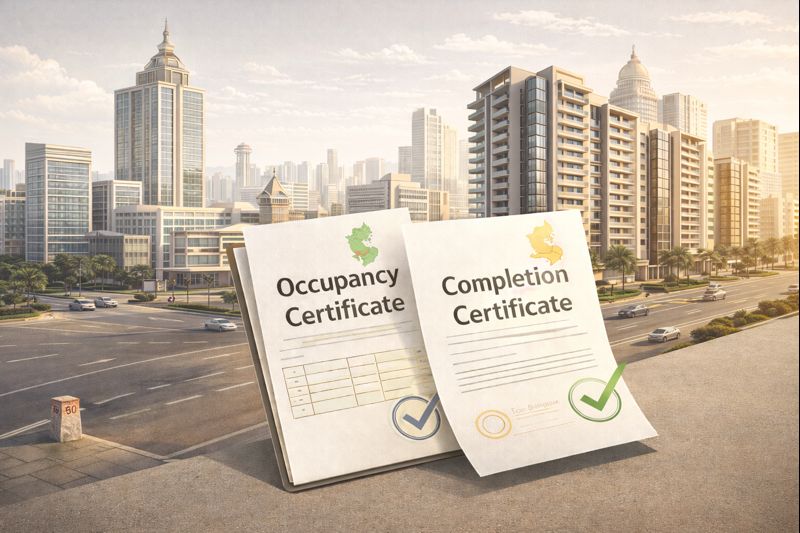
Imagine spending ₹80 lakhs on a brand-new apartment in Whitefield, only to discover months later that the builder never obtained the Occupancy Certificate. Your bank refuses to disburse the final loan instalment, BESCOM declines to provide a permanent electricity connection, and the BBMP sends a notice flagging the building as unauthorised. This is not a hypothetical scenario — it is a reality that thousands of Bangalore home buyers have faced, and continue to face, every year.
The Occupancy Certificate (OC) and Completion Certificate (CC) are two of the most critical yet most overlooked documents in any property transaction in Bangalore. Together, they confirm that a building has been constructed legally, inspected by the appropriate authorities, and is safe for human habitation. Without them, your dream home exists in a legal grey zone — one that can cost you dearly in terms of loans, resale value, utility connections, and even demolition risk.
This comprehensive 2026 guide covers everything Bangalore home buyers, NRIs, and property investors need to know about OC and CC certificates — what they are, who issues them, how to obtain them, what happens if they are missing, and how platforms like Legal Byte can help you verify these documents before you sign on the dotted line.
An Occupancy Certificate (OC) is an official document issued by the local municipal authority — primarily the Bruhat Bengaluru Mahanagara Palike (BBMP) for properties within Bengaluru's city limits — certifying that a completed building is safe, legally constructed, and fit for occupation. It is the final green light from the civic body that says: "This building is ready for people to live in."
The OC is issued only after the municipal authority physically inspects the building and confirms the following:
Key Point: The OC is your legal permission to occupy and use the building. Without it, moving into a property is technically illegal under Karnataka municipal law.
A Completion Certificate (CC) is issued by the planning or development authority — typically the Bangalore Development Authority (BDA) for BDA-layout properties, or BBMP for properties within its jurisdiction — confirming that construction of the building is complete and matches the approved plan in all material respects.
The CC is issued after verifying that:
Key Point: While the CC confirms that construction has been completed correctly and legally, the OC is what grants you the right to actually move in. In practice, both documents are essential for a legally sound property purchase in Bangalore.
| Aspect | Occupancy Certificate (OC) | Completion Certificate (CC) |
|---|---|---|
| Issued By | BBMP (for BBMP-limit properties) | BDA / BBMP / Relevant Planning Authority |
| Primary Purpose | Permission to occupy the building | Confirms construction is complete and compliant |
| Focus Area | Safety, habitability, infrastructure | Plan compliance and construction completion |
| Required For | Moving in, utility connections, home loans | Registering the property, obtaining OC |
| When Issued | After final inspection post-construction | Upon completion of construction |
| Legal Consequence if Missing | Occupation is technically illegal | Building may be deemed unauthorised |
| Applicable To | Apartments, villas, commercial buildings | All types of constructed buildings |
In many cases, especially for apartment complexes in Bangalore, the terms OC and CC are used interchangeably by builders and buyers. However, they are legally distinct documents, and a diligent buyer should verify both.
A property without an OC is considered unauthorised under the Karnataka Municipal Corporations Act and the BBMP Building Bye-Laws. This means the building — or portions of it — could be subject to demolition orders or regularisation notices from BBMP. In 2025 and 2026, BBMP has intensified its drive against unauthorised constructions across Bangalore, making OC verification more critical than ever.
Almost every scheduled bank and housing finance company in India requires the OC as a mandatory document before disbursing a home loan — particularly the final instalment. Without an OC, your lender may refuse to release funds, leaving you in a financial bind. The Reserve Bank of India's guidelines on housing loans also emphasise the importance of OC as a title-related document.
BESCOM (Bangalore Electricity Supply Company) and BWSSB (Bangalore Water Supply and Sewerage Board) require the OC before granting permanent electricity and water connections. Builders often provide temporary connections during construction, but these are not permanent and can be disconnected at any time. Without an OC, residents may be stuck with illegal or temporary utility connections indefinitely.
A property without an OC is significantly harder to sell. Informed buyers and their lawyers will flag the absence of OC as a major red flag, leading to either a failed transaction or a heavily discounted sale price. Banks will also refuse loans to buyers of such properties, further shrinking your pool of potential buyers.
Under the Real Estate (Regulation and Development) Act, 2016, and as enforced by K-RERA (Karnataka Real Estate Regulatory Authority), builders are legally obligated to obtain the OC and hand it over to the buyer or the Residents' Welfare Association (RWA) upon possession. Failure to do so is a violation of RERA provisions. In April 2026, K-RERA ordered BDA to pay ₹56 lakh in compensation for delays in providing possession — a reminder that regulatory bodies are increasingly holding authorities and builders accountable for such lapses. Buyers can file complaints with K-RERA if a builder withholds or fails to obtain the OC.
However, enforcement remains a challenge. As of early 2026, reports indicate that over ₹1,000 crore in RERA-ordered relief is yet to reach homebuyers in Bengaluru, underscoring the importance of verifying OC and CC before purchase rather than relying solely on post-purchase regulatory remedies.
The OC is also linked to the proper assessment of property tax under BBMP's e-AASTHI system. Properties without an OC may face irregular tax assessments or be flagged in BBMP records, creating complications when you attempt to pay property tax, transfer ownership, or apply for building plan modifications in the future.
Home insurance policies may be invalidated or disputed if the property lacks an OC. In the event of a structural failure or accident, the absence of an OC can expose the owner to legal liability and complicate insurance claims.
| Property Location | OC Issuing Authority | CC Issuing Authority |
|---|---|---|
| Within BBMP limits (Bangalore city) | BBMP (Bruhat Bengaluru Mahanagara Palike) | BBMP |
| BDA-approved layouts | BBMP (post-handover to BBMP) | BDA (Bangalore Development Authority) |
| Peripheral areas / CMC / TMC limits | Respective City/Town Municipal Council | Respective City/Town Municipal Council |
| BMRDA jurisdiction (outside BBMP) | Respective local body | BMRDA / Local Planning Authority |
Before construction begins, the builder or owner must obtain a sanctioned building plan from BBMP or the relevant authority. This is the foundational document against which the completed building will be measured. Without a valid BPA, neither OC nor CC can be issued.
The building must be constructed strictly in accordance with the approved plan. Any deviations — additional floors, reduced setbacks, increased FAR — can result in rejection of the OC/CC application or require regularisation under applicable schemes.
Once construction is complete, the builder or owner submits a CC application to BBMP (or BDA, as applicable) along with the required documents. BBMP's online portal allows builders to submit applications digitally. The authority then schedules a site inspection.
BBMP engineers and inspectors visit the site to verify that the construction matches the approved plan. They check setbacks, height, FAR, structural compliance, fire safety provisions (for high-rises), and infrastructure readiness.
For larger buildings and apartment complexes, additional clearances may be required from:
If the inspection is satisfactory and all clearances are in order, BBMP issues the Completion Certificate. This document confirms that construction is complete and compliant.
With the CC in hand, the builder applies for the OC. BBMP conducts a final inspection focusing on habitability — water supply, drainage, electricity readiness, lifts (if applicable), and common area facilities.
Once the OC is issued, the builder can legally hand over possession to buyers. Under K-RERA regulations, the OC must be provided to buyers at the time of possession or within a reasonable period thereafter.
Buyers can verify OC and CC status through the following government portals:
| Document | Purpose |
|---|---|
| Sanctioned Building Plan (approved copy) | Baseline for compliance verification |
| Building Plan Approval Order | Proof of original approval from BBMP/BDA |
| Commencement Certificate | Confirms construction was legally started |
| Structural Stability Certificate | Issued by a licensed structural engineer |
| Fire NOC (for buildings above specified height) | Karnataka State Fire and Emergency Services clearance |
| BESCOM Electrical Clearance | Confirms electrical installation is safe |
| BWSSB Connection Approval | Water and sewerage connection readiness |
| Khata Certificate and Khata Extract | Confirms property is in BBMP records |
| Tax Paid Receipts | Proof of property tax compliance |
| Photographs of Completed Building | Visual evidence of construction completion |
| Architect's Completion Certificate | Certified by the project architect |
| K-RERA Registration Certificate (if applicable) | Mandatory for projects above threshold size |
This is one of the most common misrepresentations in Bangalore's real estate market. A builder may tell you that the OC has been "applied for" or is "in process" and ask you to take possession anyway. Do not accept possession without a copy of the actual OC. An application is not an OC. Insist on seeing the original document issued by BBMP.
In large apartment complexes with multiple towers, builders sometimes obtain OC for one or two towers while others remain without OC. Verify that the OC covers the specific tower and floor where your apartment is located, not just the project in general.
If the builder has constructed additional floors, reduced setbacks, or exceeded the permissible FAR, BBMP will not issue an OC for those portions. Buyers of apartments on such floors are particularly at risk. Always cross-check the sanctioned plan against the actual construction.
Some builders obtain OC for a building configuration that differs from what was actually sold to buyers — for example, obtaining OC for a residential building when certain floors were sold as commercial units, or vice versa. This creates serious legal complications for buyers.
Instances of forged OC documents have been reported in Bangalore. Always verify the OC directly with BBMP or through a trusted due diligence platform rather than relying solely on copies provided by the builder or seller.
Many older properties in Bangalore — particularly those built before 2000 — may not have OC on record, either because it was never obtained or because records were not digitised. In such cases, buyers should seek a legal opinion and explore whether regularisation is possible under applicable schemes.
In February 2026, K-RERA stepped up its crackdown on unregistered projects, flagging multiple developers for regulatory violations. If a project above the threshold size is not registered with K-RERA, it is a serious red flag — and the absence of K-RERA registration often correlates with missing OC and CC documents. Always verify K-RERA registration status before booking.
Under K-RERA, builders cannot demand more than a specified percentage of the sale consideration before the project reaches certain milestones. If a builder is pressuring you to make full payment before the OC is obtained, this is a violation of RERA provisions and a warning sign.
Karnataka has periodically introduced regularisation schemes for unauthorised constructions — most notably the Akrama-Sakrama scheme. However, these schemes have faced legal challenges and have not been consistently implemented. [VERIFY: current status of Akrama-Sakrama or any active regularisation scheme in Karnataka as of 2026]
Regularisation, even when available, involves payment of penalties, is not guaranteed for all types of violations, and does not eliminate all legal risks. It is always better to buy a property with a valid OC than to rely on future regularisation.
Verifying OC and CC documents in Bangalore is not always straightforward. Government portals can be difficult to navigate, records may be incomplete, and builders do not always cooperate. This is where Legal Byte's technology-driven due diligence services make a critical difference.
Legal Byte's flagship service, Scrutin 360, is an AI-powered property due diligence platform that analyses all critical documents related to your property — including OC, CC, building plan approval, Khata, encumbrance certificate, and K-RERA registration status. Scrutin 360 cross-references data across multiple sources to identify discrepancies, missing documents, and legal risks that a standard document review might miss.
For OC and CC verification specifically, Scrutin 360:
If your builder or seller cannot produce the OC, CC, or related documents, Legal Byte's DocGet service can retrieve them directly from official government portals on your behalf. DocGet accesses Kaveri Online, Bhoomi, BBMP e-AASTHI, and K-RERA to pull the documents you need — saving you the time and frustration of navigating complex government systems yourself.
DocGet is particularly useful for:
Whether you are buying a new apartment in Sarjapur Road, a resale villa in Whitefield, or a plot in a BDA layout, Legal Byte provides end-to-end due diligence support — from initial document collection through Kaveri Online and Bhoomi, to AI-powered risk analysis via Scrutin 360, to expert legal review by qualified property lawyers. Our platform is designed specifically for Karnataka's property ecosystem, ensuring that every check is relevant, accurate, and actionable.
The Occupancy Certificate and Completion Certificate are not mere formalities — they are the legal foundation of your property ownership in Bangalore. A property without a valid OC is a property with unresolved legal risk, regardless of how attractive the price, location, or amenities may be. In a market where enforcement is tightening — with K-RERA stepping up action against unregistered projects and BBMP intensifying scrutiny of unauthorised constructions — the consequences of buying without OC are more serious than ever before.
As a home buyer, your best protection is thorough due diligence before you commit. Verify the OC and CC directly with BBMP. Check K-RERA registration on the K-RERA portal. Cross-reference land records on Bhoomi and registered documents on Kaveri Online. Review property tax and Khata records on BBMP e-AASTHI. And if any document is missing or cannot be verified, do not proceed until the issue is resolved.
Legal Byte's Scrutin 360 and DocGet services are built to make this process fast, reliable, and accessible — whether you are a first-time buyer in Bangalore, an NRI investing from abroad, or a seasoned investor expanding your portfolio. Do not let a missing OC turn your dream home into a legal nightmare. Run a Scrutin 360 due diligence check today at legalbyte.ai and buy with complete confidence.

LegalByte (Lexipro Solutions Pvt. Ltd.) is a technology-enabled due diligence platform, not a law firm. Reports reviewed and signed off by an advocate constitute that advocate’s legal opinion, subject to the scope and qualifications stated in the report. Reports and analyses without that sign-off are informational only and do not constitute a legal opinion.
© 2025 NVIDIA, the NVIDIA logo, are trademarks and/or registered trademarks of NVIDIA Corporation in the U.S. and other countries.
