

Loading blog post...
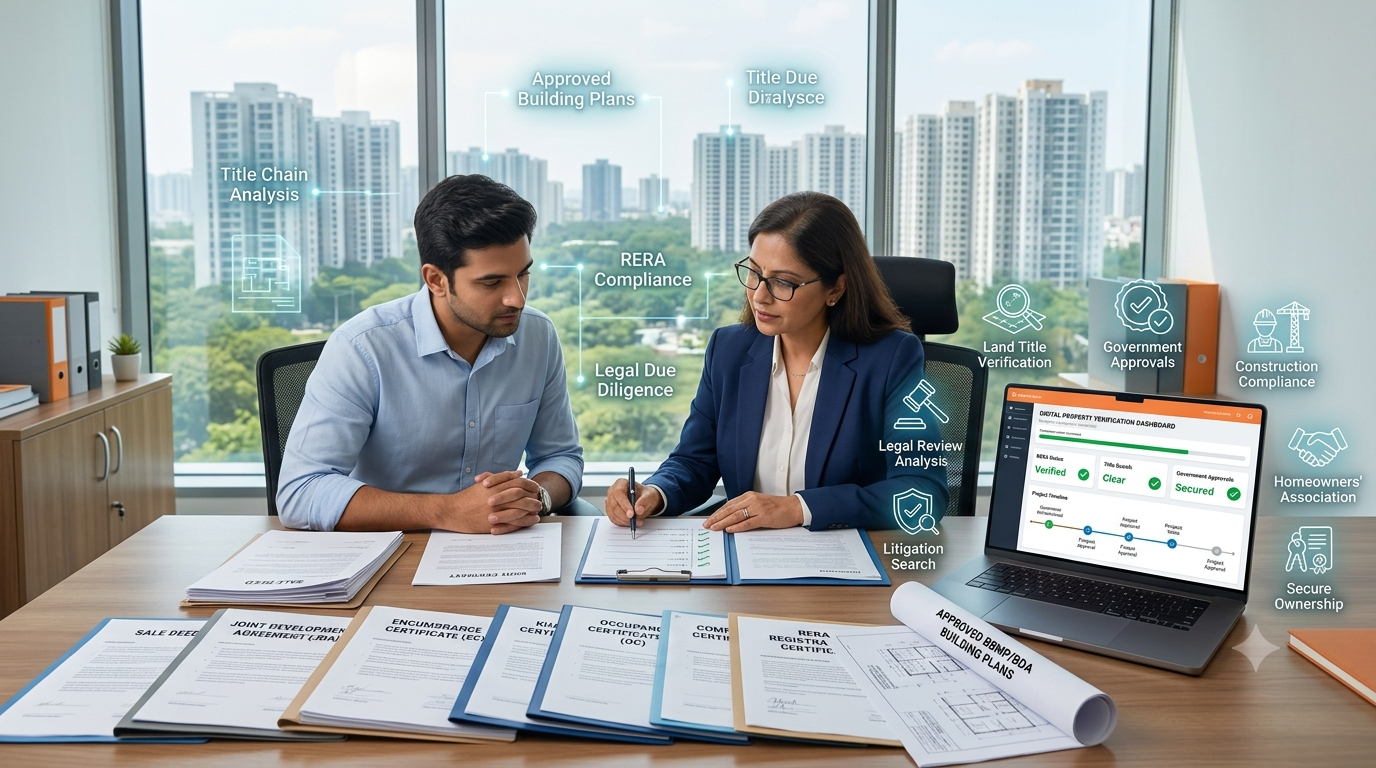
Apartments add a layer of complexity that plots don't have: you're not just checking the unit, you're checking the builder's title to the entire project, the project's regulatory approvals, and whether construction actually matches what was sanctioned. This checklist walks through every layer.
Before anything else, confirm the builder actually owns — or has valid development rights to — the land the project sits on. This means tracing the land's title chain back at least 30 years, the same as you would for a plot, but at the project level rather than the unit level.
Joint development agreements (JDAs) between landowners and builders are common in Bangalore. Check that the JDA is registered and that the builder's share of units — including the one you're buying — is clearly defined within it.
Every real estate project in Karnataka above 500 sq.m or 8 units must register with K-RERA. Check the project's registration on the Karnataka RERA portal, and confirm the registration covers the specific unit and phase you're buying — some builders register phases separately.
RERA registration is necessary but not sufficient. It confirms the project meets disclosure and escrow requirements — it doesn't verify the land title independently.
Get the BBMP or BDA-sanctioned plan for the block and compare it against what's actually been built. Deviations — an extra floor, a converted common area, a setback violation — are common and can block OC issuance or create demolition risk later.
The CC confirms construction is complete as per the sanctioned plan; the OC confirms the building is fit for occupation. A significant number of apartments in Bangalore are occupied without a proper OC — this can affect your ability to get a home loan, and it's a real problem at resale.
If a project is marketed as "OC applied for" rather than "OC received," treat that as an open item to resolve before registration, not after.
Once construction is complete, each unit should get its own khata, separate from the project's overall khata. Confirm this has happened, or that there's a clear process and timeline for it to happen after your purchase.
Check the EC for the underlying land (to catch any mortgage the builder may have taken against the project) and, once available, the EC for your specific unit. A builder mortgage on the land doesn't automatically transfer to you, but it needs to be resolved before or at registration.
For completed or nearly-completed projects, check whether the apartment owners' association has been formed and whether common areas and amenities have been formally handed over by the builder. Undocumented handovers are a common source of post-possession disputes.
Search for any pending litigation involving the builder or the project — consumer forum complaints, RERA complaints, or civil suits are all public and worth checking before you commit.
LegalByte's Full Report for apartments and layouts (₹14,000 + GST, delivered in 72 hours) runs the builder title check, RERA verification, BBMP/BDA sanction plan comparison, and OC/CC status check as standard — with a lawyer signing off on every finding.
The unit-level documents matter, but for an apartment, the builder's title and the project's regulatory status matter just as much — and they're the checks most buyers skip. See LegalByte's full due diligence service for a complete, lawyer-signed check.

LegalByte (Lexipro Solutions Pvt. Ltd.) is a technology-enabled due diligence platform, not a law firm. Reports reviewed and signed off by an advocate constitute that advocate’s legal opinion, subject to the scope and qualifications stated in the report. Reports and analyses without that sign-off are informational only and do not constitute a legal opinion.
© 2025 NVIDIA, the NVIDIA logo, are trademarks and/or registered trademarks of NVIDIA Corporation in the U.S. and other countries.
