

Loading blog post...
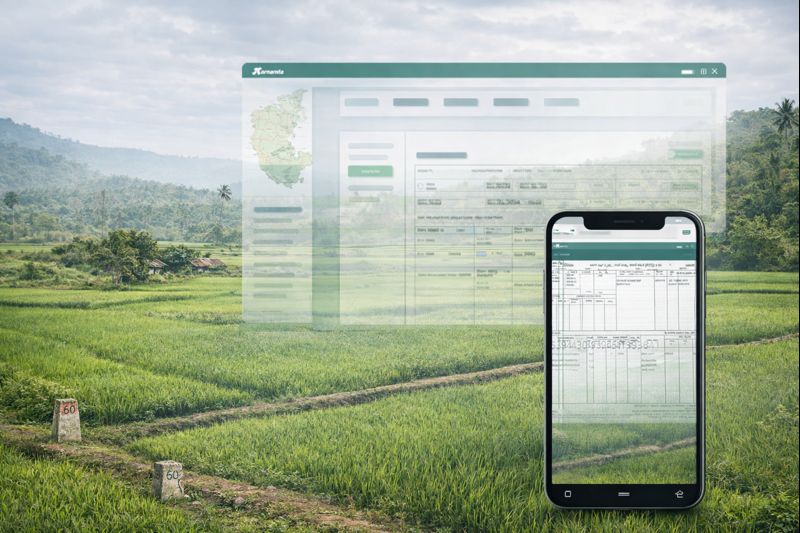
Imagine finalising a land deal in Tumkur, transferring funds, and then discovering the seller was never the legal owner of record. Or purchasing what you believed was a residential plot in Ramanagara, only to find the RTC still classifies it as agricultural land — making construction legally impossible. These are not hypothetical horror stories; they are documented disputes that Karnataka courts handle every year.
The RTC (Record of Rights, Tenancy and Crops) — known locally as Pahani (ಪಹಣಿ) — is the single most important land record document in Karnataka. It is the Revenue Department's official register of who owns land, how it is classified, whether it carries encumbrances, and who cultivates it. Before any agricultural or converted land transaction in Karnataka, verifying the RTC is not optional — it is foundational.
Karnataka's Bhoomi portal has digitised over 20 million land records across the state, making RTC verification accessible online within minutes. This 2025 guide explains what RTC/Pahani contains, why it matters for buyers, how to access it on Bhoomi, what red flags to watch for, and how Legal Byte's AI-powered tools can automate the entire verification process for you.
RTC stands for Record of Rights, Tenancy and Crops. It is an extract from the Pahani Register maintained by the Village Accountant (Patwari/Shanbhog) under the Karnataka Land Revenue Act, 1964. Every land parcel in Karnataka — identified by a unique Survey Number and, where subdivided, a Hissa Number — has a corresponding RTC entry.
The document is formally called Form 16 under the Karnataka Land Revenue Rules. When you request an "RTC" or "Pahani," you are requesting a certified extract of Form 16 for a specific survey number. This single document consolidates ownership, land use, encumbrances, water source, soil type, and cultivation details into one authoritative record.
Legally, the RTC is prima facie evidence of title in Karnataka. Courts, banks, and government authorities treat it as the starting point for any land-related inquiry. Without a clean RTC, you cannot obtain an agricultural loan, register a sale deed smoothly, or convert land for non-agricultural use.
Understanding every column of the RTC is essential for meaningful due diligence. The Form 16 extract contains the following key fields:
| Column / Field | What It Shows | Why It Matters to Buyers |
|---|---|---|
| Survey Number / Hissa Number | Unique identifier for the land parcel | Must match sale deed and mutation records exactly |
| Owner Name (Khatedar) | Registered owner(s) of the land | Seller must appear here; discrepancies indicate title risk |
| Extent of Land | Area in acres/guntas or hectares | Must match sale deed; shortfall indicates encroachment or subdivision issues |
| Nature of Land (Jirayat/Bagayat) | Dry (Jirayat) or irrigated (Bagayat) classification | Affects land value, crop suitability, and loan eligibility |
| Land Use / Classification | Agricultural, forest, government, etc. | Non-agricultural use requires DC conversion order |
| Encumbrances / Liabilities | Loans, mortgages, government dues | Outstanding liabilities transfer with the land |
| Cultivator Details | Who is actually cultivating the land | Tenancy rights under Karnataka Land Reforms Act may apply |
| Water Source | Well, tank, canal, rain-fed, etc. | Affects agricultural productivity and land value |
| Soil Type | Red, black, laterite, etc. | Relevant for construction feasibility and agricultural use |
| Mutation Number (Hissa) | Reference to last recorded ownership change | Helps trace title history and verify inheritance/sale chain |
The RTC is the Revenue Department's official record of who owns a survey number. If the person selling you land does not appear as the Khatedar in the current RTC, you are dealing with either an undisclosed transfer, an inheritance dispute, or — in the worst case — a fraudulent transaction. No sale deed, however well-drafted, can substitute for a clean RTC in the seller's name.
Under the Karnataka Land Reforms Act, 1961, agricultural land in Karnataka can only be purchased by agriculturists or entities approved by the government. If you are a non-agriculturist buying land still classified as agricultural in the RTC, the transaction is legally void. The RTC's land use column is the first place to check for this critical restriction.
Banks and cooperative societies often record agricultural loans against survey numbers in the RTC. Government dues such as land revenue arrears also appear here. These liabilities do not disappear upon sale — they follow the land. Buyers who skip RTC verification have inherited lakhs in outstanding loans without knowing it.
Every scheduled bank and housing finance company in Karnataka requires a current RTC extract before sanctioning a loan against agricultural or converted land. Lenders use it to verify ownership, check for prior mortgages, and assess land classification. An RTC with encumbrances or mismatched ownership will result in loan rejection.
If you plan to convert agricultural land for residential or commercial use, the Deputy Commissioner's office requires a current RTC as part of the conversion application. Similarly, BBMP, BDA, and local planning authorities require RTC extracts when approving layouts. An RTC with government land notations or forest classifications will block conversion entirely.
The cultivator column in the RTC can reveal whether a tenant has been cultivating the land for an extended period. Under the Karnataka Land Reforms Act, long-term tenants may have acquired occupancy rights that cannot be extinguished simply by a sale. Discovering this after purchase can result in protracted litigation and loss of possession.
The Bhoomi portal (bhoomi.karnataka.gov.in) is Karnataka's official land records management system, administered by the Revenue Department. It hosts digitised RTCs for all districts and allows online viewing, downloading, and ordering of certified copies. Here is the complete process:
If you are an NRI, a busy professional, or dealing with a rural survey number that is difficult to locate on Bhoomi, Legal Byte's DocGet service retrieves your RTC directly from the Bhoomi portal on your behalf. Simply provide the district, taluk, village, and survey number — DocGet handles the rest and delivers a verified copy to your inbox, eliminating the need to navigate government portals yourself.
| Document | Purpose | Where to Obtain |
|---|---|---|
| Survey Number / Hissa Number | Mandatory to search RTC on Bhoomi | Previous sale deed, tax receipts, or seller |
| Previous Sale Deed | Cross-verify owner name and extent with RTC | Seller / Kaveri Online (registered copy) |
| Mutation Register (MR) Extract | Trace ownership change history linked to RTC | Bhoomi portal or Nadakacheri |
| Encumbrance Certificate (EC) | Verify registered transactions against the survey number | Kaveri Online |
| DC Conversion Order | Confirm land has been legally converted from agricultural use | Deputy Commissioner's office / seller |
| Sketch / Village Map (Tippani) | Identify physical boundaries of the survey number | Survey Department / Bhoomi portal |
| Aadhaar / Identity Proof | Required for Nadakacheri application and online login | Applicant |
| Land Revenue Receipt | Confirm payment of government dues; cross-check with RTC | Seller / Bhoomi portal |
A raw RTC extract contains far more information than most buyers know how to interpret. Here are the most critical red flags that should trigger immediate further investigation before any purchase:
This is the most common and dangerous red flag. If the person selling you the land is not listed as the owner in the current RTC, the mutation has either not been completed after a previous sale or inheritance, or the seller has no legal title at all. Do not proceed until the RTC reflects the correct owner through a completed mutation process.
RTCs sometimes carry notations indicating that the land is government land (Sarkari), forest land, or assigned land (granted to SC/ST beneficiaries). Assigned land carries strict restrictions on sale. Government and forest land cannot be privately owned. Purchasing such land is legally void and may expose you to criminal liability.
If the RTC shows a bank or cooperative society loan against the survey number, the land is mortgaged. The lender has a charge over the property. You must obtain a No Objection Certificate (NOC) from the lender and ensure the loan is cleared before or at the time of registration. Failing to do so means you inherit the mortgage.
Sellers sometimes claim DC conversion has been obtained but the RTC still shows agricultural classification. This means either the conversion order was never updated in the revenue records, or the conversion itself is disputed. Always verify the DC conversion order independently and check whether the RTC has been updated to reflect non-agricultural status.
When the RTC lists multiple co-owners (common in inherited land), all co-owners must consent to the sale. A sale by one co-owner without the others' consent is legally challengeable. Verify that all persons listed in the Khatedar column are parties to the sale deed.
If the area mentioned in the sale deed differs from the extent recorded in the RTC, it could indicate encroachment, illegal subdivision, or measurement errors. Even a small discrepancy of a few guntas can create significant legal complications during future resale or construction.
If the cultivator column shows a name different from the owner, investigate whether that person has acquired tenancy rights. Under the Karnataka Land Reforms Act, tenants who have cultivated land for a specified period may have occupancy rights that survive a sale. This can make it impossible to take physical possession of the land.
Some RTCs carry notations indicating that the land has been acquired or is under acquisition by NHAI, BDA, KIADB, or other government bodies. Purchasing such land means you may receive only the government's compensation amount — not the market value you paid — and may lose the land entirely.
| Document | Issued By | What It Shows | Portal |
|---|---|---|---|
| RTC / Pahani (Form 16) | Revenue Department (Village Accountant) | Ownership, land use, encumbrances, cultivation | Bhoomi |
| Encumbrance Certificate (EC) | Sub-Registrar's Office | Registered transactions (sales, mortgages) on the property | Kaveri Online |
| Mutation Register (MR) | Revenue Department | History of ownership changes recorded in revenue records | Bhoomi |
| Property Tax Records | BBMP / Local Body | Tax payment history for urban properties | BBMP e-AASTHI |
| RERA Registration | Karnataka RERA | Builder/project registration for apartment purchases | K-RERA |
| DC Conversion Order | Deputy Commissioner's Office | Permission to use agricultural land for non-agricultural purposes | Offline / Revenue Dept. |
The Karnataka Revenue Department has continued to upgrade the Bhoomi portal with several significant improvements that buyers and lawyers should be aware of:
Manual RTC verification requires navigating multiple government portals, cross-referencing data across documents, and knowing exactly what red flags to look for. For most buyers — especially NRIs and first-time land purchasers — this is both time-consuming and technically demanding. Legal Byte's AI-powered platform eliminates this complexity.
DocGet retrieves your RTC extract directly from the Bhoomi portal without you having to navigate the portal yourself. Whether you are dealing with a rural survey number in Haveri or a converted plot in Bengaluru Rural, DocGet locates the correct survey number, retrieves the current RTC, and delivers it to you in a clean, readable format. DocGet also retrieves related documents including Mutation Register extracts, Encumbrance Certificates from Kaveri Online, property tax records from BBMP e-AASTHI, and project details from K-RERA — giving you a complete document package for due diligence.
Scrutin 360 goes beyond document retrieval. It is Legal Byte's comprehensive AI-powered property due diligence service that analyses your RTC alongside all other relevant documents to produce a structured risk report. Here is what Scrutin 360 does with your RTC:
For NRI buyers who cannot visit Karnataka in person, Scrutin 360 provides the confidence of a thorough due diligence review conducted remotely, with all documents retrieved digitally and analysed by AI trained on Karnataka's specific land laws and revenue records framework.
The RTC/Pahani is not a bureaucratic formality — it is the foundation of every safe land transaction in Karnataka. It tells you who legally owns the land, how it is classified, what liabilities it carries, and whether possession is likely to be peaceful. Skipping or superficially reviewing the RTC is one of the most common — and most costly — mistakes that Karnataka land buyers make. In a state where agricultural land restrictions, tenancy rights, and government acquisition notifications can silently invalidate a purchase, the RTC is your first and most important line of defence.
The good news is that Karnataka's Bhoomi portal has made RTC access easier than ever before. But access is only the first step — knowing what to look for, how to cross-reference it with other documents, and how to interpret red flags requires expertise that most buyers do not have. This is precisely where Legal Byte's technology makes a meaningful difference. Whether you need a quick document retrieval or a comprehensive due diligence report, our tools are built specifically for Karnataka's land records ecosystem.
Before you sign any agreement or transfer any funds for a Karnataka land purchase, let Legal Byte verify the RTC and all related documents for you. Use DocGet to retrieve your RTC, Mutation Register, and Encumbrance Certificate from Bhoomi and Kaveri Online instantly — or run a full Scrutin 360 due diligence to get a complete AI-powered risk assessment of your property. Visit legalbyte.ai to get started today and buy Karnataka land with confidence.

LegalByte (Lexipro Solutions Pvt. Ltd.) is not a law firm and does not provide legal advice. Reports are for informational purposes only and do not constitute legal opinion. Engage a qualified advocate for registration, disputes, or complex transactions.
© 2025 NVIDIA, the NVIDIA logo, are trademarks and/or registered trademarks of NVIDIA Corporation in the U.S. and other countries.
